
Weobley High – Music
Welcome to Weobley High School’s Music Department. We are an extremely busy and 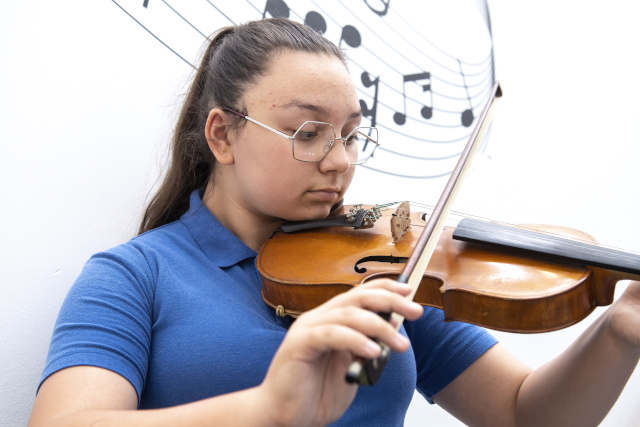 committed team who encourage all our musicians to develop their talents by giving them many opportunities to showcase and celebrate their successes.We make a substantial contribution to the life of the school as well as our local community.
All pupils study Music in Years 7, 8 and 9 and follow a course which is based on national curriculum requirements which ensures progression across Key Stage 3.
Schemes of work are broad and varied, combining traditional and modern approaches to music making.
Throughout Key stage 3 all pupils assessment results/progress/skills are recorded in pupils’ individual files which are kept in the classroom.
Pupils study AQA GCSE music in year 10 + 11 receiving 2 one hour lesson.s
All course work is marked according to the marking criteria in line with the specification.
Resources
The Department has two Music teachers, augmented by six visiting peripatetic teachers who visit the school each week to provide tuition for instrumentalists and singers. These lessons take place either during school hours, on a rota basis, or at lunch times.
Music resources are modern and up to date. Our infrastructure provides an excellent learning environment, with a classroom set up with keyboards for performance tasks, practice rooms and ICT facilities with a set of classroom IPads used for composition tasks.
Extra -Curricular Activities
Music is a thriving and important part of school life and we aspire for high standards of music making. 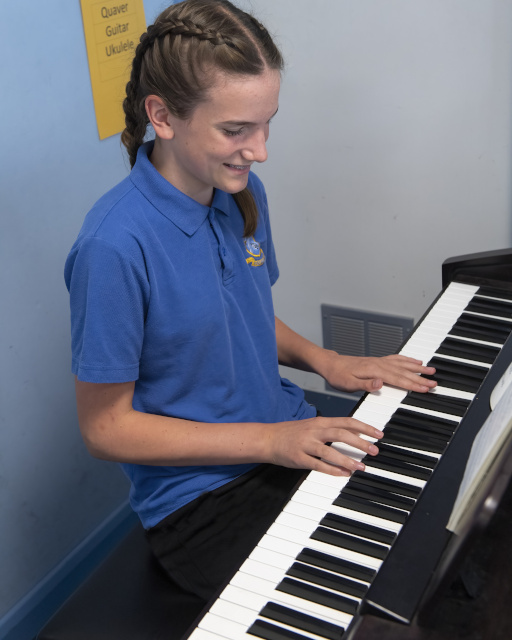
The school has a large choir and soloists who have the opportunity to perform in Presentation Evenings, Carol Services as well as Concerts.
The school has taken part for the last 2 years in annual ABF Christmas Concert at Hereford Cathedral, singing to over 400 people.
There is a major musical production every other year which is always a great success. Recent musicals have included: ‘Scrooge’, ‘The Boyfriend’, ‘The Sound Of Music’, ‘The King And I’, ‘Grease’, ‘Annie’ , ‘We Will Rock You’ and :The Wiz’. Our most recent production, Little Shop of Horrors, in 2017 was a huge success.
Marking and Assessment
The assessment sections of the schemes of work will indicate the musical focus and the skills, knowledge and understanding which need to be demonstrated in a particular unit of work.
Practical work is marked and assessed as individual pupils attain the levels linked to clear criteria within each unit.
Oral feedback from pupil to teacher, teacher to pupil and pupil to pupil forms part of the dialogue that relates directly to learning objectives and outcomes.
In music lessons the oral feedback (Formative assessment) is constructive and informative and enables pupils to take the next steps in their learning.
Written feedback (Summative and Formative Assessment) is given at the end of each unit of work so pupils are able to reflect on the strengths and weaknesses of their work and identify ways in which they can improve.
Pupils’ work should be praised as much as possible and merits awarded as appropriate.
Intent
The philosophy of the department is to aim to develop a child’s self-confidence and personal expression. The music department’s premise is that music is for all regardless of gender, race, or ability. We aim to build success into every lesson and extend curricular opportunities for every student.
The value of musical experience is many sided. It offers enjoyment and recreation; emotional satisfaction; and opportunities for individual and group activities; therefore, promoting creativity and expression.
Music involvement should be immediate and for everyone therefore this will lead to a development of musical imagination. Our department sees students as musical inventors, composers, and improvisers. We as teachers move from the role of a director to a facilitator who stimulates student’s thoughts and imagination and advise rather than show and tell. However, no credible theory of music education can be sustained without an insightful analysis of music.
Music education is, however, more than just having experiences or about acquiring a repertoire of skills. It is about developing insightfulness, understanding and quality of mind.
At Weobley High School we believe that:
- Every student has the right to learn and take part in musical activities.
- No music student is left behind.
- Students should be given the opportunities to learn how to express themselves musically.
- Students should be given the opportunities to understand how to build meaningful relationships using music.
- Musical knowledge embraces different traditions.
Implementation
At KS3 we study Music to build confidence through performance and to develop self-discipline through rehearsal and preparation. We study Music to push ourselves to refine and improve our creative responses. We study Music to gain an appreciation and understanding of the rich and varied history of music from all around the world and to develop transferable skills that we will inevitably use in all other areas of our learning, tapping into multiple skill sets often simultaneously.
At KS3 our curriculum allows students to have a deeper understanding of a wide range of topics such as……
Our curriculum provides challenge across a wide range of musical styles in keeping with both the National Curriculum and the Model Music Curriculum March 2022
Each year group has a set of key vocabulary as well as set songs to study and perform with a list of recommended listening pieces from a variety of genres and styles.
This ensures that pupils possess a solid foundation on which to base their KS3 studies.
At KS4 we believe that students deserve a broad and ambitious music curriculum, as well as following the AQA music specification. We want students to be rich in skills and knowledge, which ignites curiosity and prepares them well for future learning or employment. Our music curriculum will give students the opportunity to:
- Develop a thorough understanding of music, through performing, composing listening and analysing.
- Develop self-confidence through performance, both through lessons and extra-curricular participation
- Encourage creativity through composition skills
- Understand the complexities of music through analysis of a wide range of genres from different musical and cultural perspectives
- Encourage personal development through ensemble performances and group compositions
- Understand how music can support the development of life skills, such as confidence, self-awareness, perseverance and discipline and provide a holistic experience that they can take beyond their musical studies
- Develop their cross-curricular skills of problem solving, perseverance, diligence, team work, time management, organisation, responsibility and cultural history
- Gain a sense of achievement through performance.
Units include Step Up To Music GCSE, Riff Ostinati and Loops, Compositional Devices, Sequences and Popular Music.
Impact
Assessment happens in a number of ways including performing, questioning, listening tests and short questions. Set works essay style questions, Music First applications.
We measure the impact of our curriculum by:
Learning walks, lesson observations
Professional dialogue with teachers
Links with HUBS and Encore Enterprises
Pupil engagement and teacher feedback
Improved subject vocabulary, set singing material and listening lists.
Attainment and achievement outcomes
Attendance and behaviour monitoring and data
Musicals, shows and choir concerts.
Instrumental tuition
Links to community, Encore Music Service and Hubs Boards.